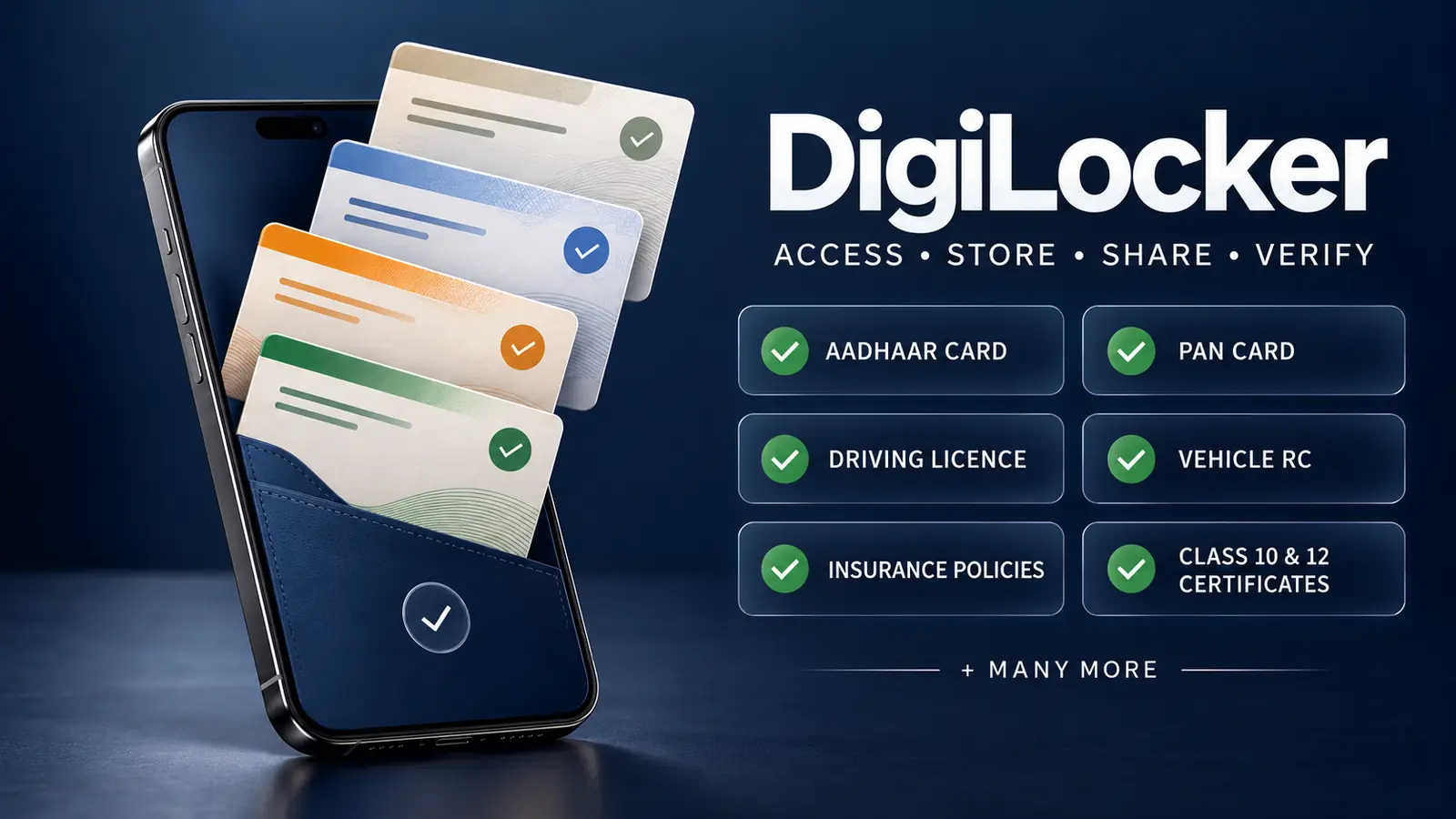
In an Indian home, official papers are rarely treated like ordinary papers. School certificates are wrapped in plastic; degrees go into bank lockers; vehicle papers stay in the glove compartment. Families keep several photocopies because the original is considered too precious to carry. Lose one sheet, and the result can be repeated trips to an office that may be in another city.
The paper chase has not disappeared, but India has built a national system that can end much of it. DigiLocker gives citizens a secure platform through which they can obtain, keep and share authentic digital documents issued by recognised authorities. The official platform now reports more than 70 crore registered users and over 900 crore issued documents. At that scale, DigiLocker has become part of India’s administrative life.
The international comparison needs care. Several European countries have sophisticated electronic identity systems, and some have offered digital public services for years. The European Union is now working towards a common wallet for all its member states. The United States has a federal sign-in service and a growing number of state-level digital credentials. Yet neither has deployed a public-document system with DigiLocker’s combination of national reach, institutional breadth and population scale.
India moved early, built for its own conditions and now runs a system at a scale many wealthier democracies are still trying to reach.
Why DigiLocker is different from cloud storage
DigiLocker is often called a digital briefcase. I think that undersells it. A briefcase carries whatever its owner puts inside; DigiLocker can connect a record to the authority that issued it.
A scanned certificate saved on a phone is only an image of a document. The person receiving it may still need to contact the issuing authority, compare records or ask for the original. A document issued through DigiLocker follows a different route. An authorised institution places the electronic record in the system. The citizen can retrieve it, and a permitted organisation can verify it against the issuer’s record. The chain between issuer, document holder and verifier remains intact.
That connection is its real value. A university marksheet issued through the National Academic Depository can be checked as an authentic institutional record. The same principle applies to supported driving and vehicle documents, government certificates and other records available through participating issuers.
India’s legal framework gives electronic records and digital signatures formal recognition. DigiLocker operates under the Information Technology Act and the Digital Locker Rules, while departments and regulators issue their own directions for particular uses. In education, academic credentials issued through DigiLocker’s National Academic Depository are legally valid and can be used in place of the corresponding physical documents. With the student’s consent, an employer, university or government body can verify a record without taking custody of an original or circulating photocopies through several hands.
An important qualification should remain clear. A document supplied directly by an authorised issuer carries a different assurance from a file that a user has uploaded for personal storage. The first can be authenticated through the DigiLocker ecosystem. The second may still require ordinary verification. Public understanding of that difference will become increasingly important as more services accept digital records.
The hidden cost of carrying paper
Paperwork imposes costs that rarely appear in a government budget. A citizen may lose a day travelling to an office, spend money on copies and attestations, then return because one signature is missing. The department must store the papers, locate them and decide whether they are genuine. Employers and universities may wait weeks for an institution to confirm a record.
The burden falls hardest on people who live far from the authority that issued the original record. A graduate working in another state may need a marksheet from a university hundreds of kilometres away. A family that moves home can misplace a certificate during transit. Flood, fire or simple deterioration can damage documents that are difficult to replace. In each case, the piece of paper becomes more powerful than the fact it is meant to prove.
DigiLocker changes the economics of that interaction. Once an authentic record is available digitally, the citizen can retrieve it without returning to its place of issue. The receiving organisation can check the source instead of judging a photocopy. Applications can move without the delays created by couriers, physical files and manual correspondence. The saving may be an hour in one case and several weeks in another. For the citizen, the gain is measured in time recovered and journeys avoided.
How the Modi government took DigiLocker to national scale
DigiLocker was launched on 1 July 2015, the day the Digital India programme began. The government led by Prime Minister Narendra Modi was making a larger choice: digital technology would become a basic instrument of governance rather than one more counter at its edge.
India had e-governance projects before 2014, and many capable institutions had already built valuable systems. The persistent weakness was fragmentation. A department could digitise its own work while leaving citizens to navigate different portals, passwords, formats and rules. A useful pilot could remain confined to one ministry or one state. Digital India created the expectation that successful platforms should be national, interoperable and designed for mass use.
The Modi government deserves credit for maintaining that direction over more than a decade. An application can be unveiled in an afternoon. National infrastructure is built slowly. Public bodies and institutions have to issue compatible records, rules for access and verification must work, and citizens need a reason to return.
The growth to more than 70 crore registered users and over 900 crore issued documents shows what patient institutional integration can produce. It also reflects the work of the Ministry of Electronics and Information Technology, the National e-Governance Division, state governments, educational authorities and participating departments. Sustained political direction gave the project continuity, and cooperation across government made it useful.
This approach has become a recognisable feature of the Modi years. Aadhaar, the Unified Payments Interface, direct benefit transfers and DigiLocker serve different purposes, but each provides common digital rails that other services can use. At India’s scale, that model can deliver what isolated applications cannot.
Where DigiLocker changes everyday life
Education provides perhaps the clearest example. Since 2020, the National Academic Depository has operated through DigiLocker. School boards, universities and other authorised institutions can issue marksheets, degrees, diplomas and certificates as digital records. Students can retrieve those credentials and share them, with consent, for admissions, employment or official verification.
That matters because academic verification in India has often depended on letters, sealed envelopes, physical visits and the availability of old institutional records. The delay harms honest candidates while forged certificates exploit the weakness of manual checking. A record issued by the institution and verified through the system shortens that process for everyone involved. Integration with e-Sanad can also support online verification, attestation and apostille for records from participating issuing authorities, helping Indians who need documents for education or employment abroad.
Transport documents bring the benefit into daily life. Supported driving licences and vehicle registration certificates can be fetched on a phone and presented through authorised digital services. For routine use, that reduces the need to carry irreplaceable originals in the glove compartment. The advantage is modest on an ordinary day and considerable when a physical document has been forgotten, lost or damaged.
The platform reaches beyond education and transport. Its catalogue includes identity-related records, government and public-sector documents, health and wellness records, skill and vocational certificates, and documents from industry and private-sector issuers. The precise availability depends on the relevant issuing authority, but the architecture is designed to let many institutions use the same citizen-facing wallet.
The common architecture matters more than any single document. A young person can move from a school marksheet to a university degree and an employment verification without rebuilding the paper trail at every stage. A worker who changes cities can retain access to records issued elsewhere. A citizen can share the required record without handing over a folder of unrelated personal information.
DigiLocker also offers resilience. India regularly faces floods, fires, earthquakes and displacement. Physical papers can disappear in one night. A retrievable issuer-backed record cannot replace every original in every circumstance, but it reduces the chance that the loss of a folder also erases a citizen’s practical ability to prove education, ownership, eligibility or identity.
The same idea is being extended to organisations through EntityLocker. Businesses and institutions can manage records such as PAN certificates, GST registrations, Udyam certificates and supported licences in an organisational account. Document portability can reduce compliance work for enterprises as well as individuals.
The comparison with Europe and the United States
India should make the comparison with confidence, though not with exaggeration.
Europe is not digitally backward. Estonia, Denmark and several other countries have built respected electronic identity and public-service systems. The European Union’s challenge is different: it must make credentials work securely across countries that retain their own institutions and identity arrangements. Under the current timetable, the European Digital Identity framework requires member states to provide wallets by the end of 2026, and large-scale pilots have tested uses including public services, driving licences, education credentials, health information and electronic signatures.
That programme is ambitious and may eventually offer capabilities beyond those available through DigiLocker, particularly for selective disclosure and cross-border use. The comparison is about timing and deployment. India launched DigiLocker in 2015 and has already taken it to hundreds of millions of registered users. Europe is still unifying its systems into a common framework.
The United States presents another contrast. Login.gov gives people one secure account for participating government websites and can verify identity, but it is an authentication service rather than a document wallet. Some states also support mobile driving licences or digital identity cards. These are useful advances, but they do not amount to a nationwide wallet through which citizens can retrieve and share a broad range of issuer-backed federal, state, educational and other public documents.
American federalism and Europe’s multinational structure help explain the difference. Their fragmentation does not reflect a lack of technological ability. Rules on identity, privacy and public records are divided among many authorities. India, however, is also a federal democracy with powerful states, multiple languages and enormous administrative variation. Building a national platform in those conditions is why DigiLocker deserves international attention.
India also had to design for scale from the beginning. A service that works for a small, highly connected population may fail when exposed to hundreds of millions of users, uneven connectivity and institutions with very different technical capacities. DigiLocker’s growth shows that India can build public technology for those conditions.
What India must protect as DigiLocker grows
National pride should not turn into complacency. A platform holding access to sensitive personal records must earn trust every day. Security cannot be treated as a certificate obtained once. Systems must be tested continuously, access must remain consent-based, and citizens need a clear record of who requested their information. When consent is withdrawn, future access should stop promptly.
Accuracy is equally important. If an issuing authority provides the wrong name, date or qualification, the citizen needs a correction process that is easy to find and capable of producing a timely answer. Otherwise, digital efficiency merely makes an error travel faster. Responsibility must be clear between DigiLocker and the institution that owns the underlying record.
Government departments also need to follow the policy in practice. Citizens should not be forced to print a digitally issued document because an office is unfamiliar with its own government’s platform. Training frontline staff and enforcing acceptance rules are less glamorous than launching new features, but they determine whether the promise reaches the counter.
Nor should digital access become the only route to essential services. Some Indians do not own a suitable phone, have unreliable connectivity or need assistance using an application. Physical and assisted alternatives remain necessary. The success of digital public infrastructure should widen access, never turn technical difficulty into a new form of exclusion.
Demanding these safeguards is a sign that DigiLocker has become essential, not an argument against it. A national system must pair convenience with restraint, strong security and effective redress.
India often debates its digital achievements through the language of catch-up, as if the country were still closing a gap defined elsewhere. DigiLocker deserves a different place in that conversation. It shows an India that identified a common administrative burden, built shared infrastructure around it and reached a scale that few democracies have matched.
The world does not need to be told that every Indian system is superior, nor should India ignore useful lessons from the European emphasis on privacy and selective disclosure or the American experience with decentralised credentials. Quiet confidence is more persuasive. India can present DigiLocker as a working public institution, explain what it has learned and invite other countries to adapt the model to their own constitutional arrangements.
Prime Minister Narendra Modi’s contribution lies in making this kind of scale politically important. Under Digital India, technology has increasingly been judged by whether it reduces friction in the life of an ordinary citizen. DigiLocker passes that test whenever a person retrieves an authentic record in seconds instead of searching for a folder, arranging an attestation or returning to the office that issued it years earlier.
DigiLocker should now be recognised alongside India’s other major digital public platforms. Its effect is quieter than an instant payment, but it addresses a burden that can follow citizens for decades. A citizen who can carry authentic public records in a pocket carries a little less bureaucracy on the shoulders.