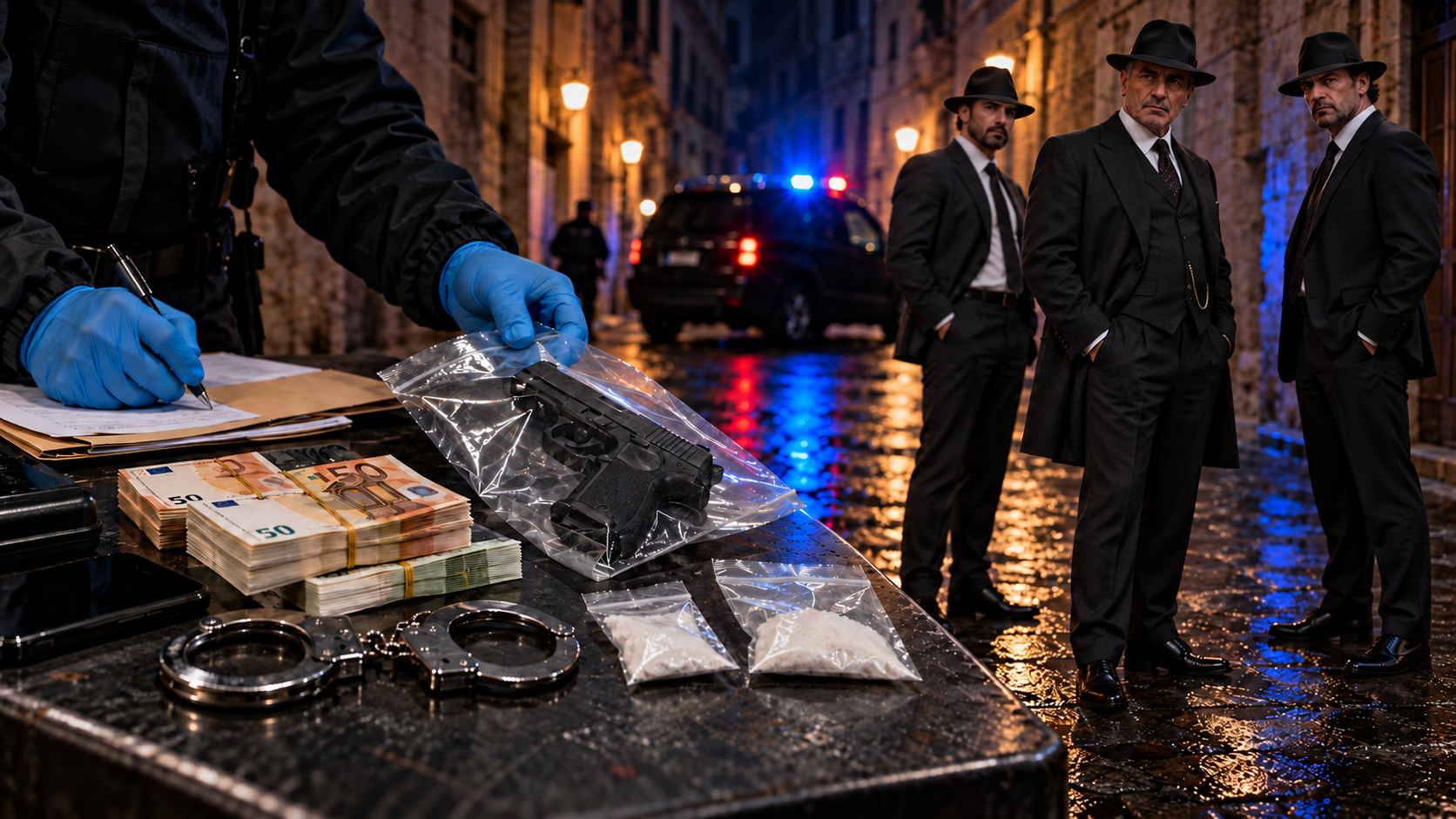
On 9 October 2026, Italy's anti-mafia investigators reported preventive confiscations worth more than €1.5 million in cases involving concrete businesses and a public official linked to Camorra clans. The announcement concerned earlier arrests and convictions. Its significance lies in the connections between criminal organisations, commercial activity and public office.
Source: Direzione Investigativa Antimafia, 9 October 2026.
A confiscated company deserves as much scrutiny as a captured boss. Who dealt with it? Who benefited? Which decisions allowed criminal interests to enter ordinary business?
Those questions belong at the centre of any serious discussion of the Italian mafias. Arrests matter. So do the financial relationships and institutional weaknesses that remain after an arrest.
This is not an accusation against any single government. It is a systemic problem extending across decades, administrations and borders. That makes responsibility broader, not weaker. Every government remains accountable for the institutions it oversees, and every person who knowingly assists organised crime must answer for that assistance.
The 1970s explain part of the present
There is no single Italian mafia. Cosa Nostra, the 'Ndrangheta, the Camorra and Apulia's criminal organisations have distinct histories. Treating them as interchangeable obscures how they accumulated influence and how the authorities have challenged them.
During the 1970s, Sicilian involvement in heroin trafficking helped connect territorial power with international criminal markets. The FBI's historical account records the subsequent American-Italian investigation into the Sicilian heroin network known as the Pizza Connection. Italian-American organised crime and the organisations based in Italy were connected in particular cases; they were not one universal hierarchy.
In Calabria, kidnapping proceeds contributed to the 'Ndrangheta's expansion into other activities. John Paul Getty III's 1973 abduction remains a notorious example of that period. Ransom money belonged to a wider history of capital accumulation and criminal investment.
In Campania, Raffaele Cutolo founded the Nuova Camorra Organizzata in 1970. Official police history traces its activities through cigarette smuggling, drugs and extortion. The date marks the creation of Cutolo's organisation, not the birth of the Camorra itself.
| Organisation | Historical base | Important distinction |
|---|---|---|
| Cosa Nostra | Sicily | Local families and coordinating structures; major historical heroin connections. |
| 'Ndrangheta | Calabria | Family-based groups with extensive international trafficking relationships. |
| Camorra | Naples and Campania | Multiple clans and alliances, rather than one permanent command. |
| Apulian groups | Puglia | Sacra Corona Unita is one component; it emerged in the early 1980s. |
Sources: Europol's 2013 assessment and Italian parliamentary records.
The continuity is important. Violence, commercial influence and corruption have long coexisted. Modern investigations do not reveal a sudden discovery of business by organisations previously concerned only with guns.
International reach is documented
INTERPOL's current I-CAN assessment describes the 'Ndrangheta as having expanded into more than 84 countries. It identifies drug trafficking, money laundering, extortion and interference with public contracts, with illegal profits reinvested in regular companies. International presence can involve associates, investments or logistical connections; it does not mean control of those countries.
Source: INTERPOL, I-CAN Phase 2 threat assessment, checked 10 October 2026.
A DIA release dated 30 September 2026 describes seven arrests in Brazil on 17 September concerning an alleged South America-Europe cocaine and laundering network associated with the 'Ndrangheta. These are investigative allegations, not final convictions.
Source: Direzione Investigativa Antimafia, Operation Eredità release, 30 September 2026.
Eurojust's account of a coordinated 2023 operation also describes criminal investment in property, restaurants, hotels, supermarkets and other commercial activities. Its assessment identifies bribery alongside trafficking and violence.
Cosa Nostra also remains a subject of major investigations. In February 2025, a Palermo operation targeted 181 suspected members amid an alleged attempt to rebuild organisational structures. The investigation challenges the assumption that capturing prominent fugitives necessarily ends the networks around them. Its allegations must still be distinguished from final judgments against individual defendants.
Source: ANSA, Palermo operation report, 11 February 2025.
The geographical scale demands a response beyond national boundaries. A criminal investigation can begin in one country while relevant assets, witnesses and companies are elsewhere. Authorities need to exchange evidence and pursue the financial connections together. A national arrest should begin the examination of those connections, not end it.
Hidden power includes the people who make it possible
The question about protection is unavoidable: how do networks maintain international trafficking and commercial interests, and who helps them do so?
The evidence establishes corruption as an enabling factor. It does not establish that every operation is directed or protected by a country's highest political leadership. Those are different claims, requiring different evidence.
The public official described in the October 2026 DIA announcement had already received multiple convictions. Official complicity therefore belongs in the record, rather than being dismissed as speculation.
UNODC's guidance explains how corrupt officials can facilitate trafficking, obstruct complaints and deprive victims of protection. Abuse at a particular checkpoint, office or enforcement agency can have serious consequences without every institution participating.
Investigators should follow assistance wherever the evidence leads: to intermediaries, professional advisers, businesspeople, officials or political figures. Position must never provide immunity from scrutiny.
Equally, a job title or business relationship alone cannot establish guilt. The task is to identify knowledge, conduct, financial benefit and responsibility. Careful evidence strengthens accountability; indiscriminate accusation gives the guilty an opportunity to hide among the wrongly accused.
A systemic diagnosis must lead to individual consequences. Otherwise, calling something a system problem becomes an excuse for leaving everyone in place.
There is a practical test for that diagnosis. Do investigations examine the people who supplied services and access as closely as the people accused of moving drugs? Do oversight bodies establish whether warning signs were ignored? Rank should increase scrutiny. It should never close an investigation's doors.
Human trafficking cannot be left out
The connection to exploitation is documented in particular mafia markets. Europol's 2013 assessment identified the Sacra Corona Unita's involvement in exploiting trafficked people in prostitution and agricultural labour. That is a specific finding about a particular organisation at a stated time.
More recently, Eurojust reported a November 2025 Italy-Romania operation against a network suspected of trafficking and exploiting more than 30 women. Nineteen suspects were detained. That release concerned a separate criminal group; it did not identify the network as one of Italy's principal mafia organisations.
Source: Eurojust, Italy-Romania trafficking operation release, 19 November 2025.
These distinctions matter because human trafficking involves exploitation, not simply movement across a border. A victim can be exploited within one country. Migrant smuggling and trafficking are distinct offences, although circumstances can overlap.
UNODC's 2025 study, Hidden Links, describes corruption as a significant facilitator of trafficking. It also identifies persistent failures to report, investigate and prosecute the connection between the two crimes.
That finding deserves political attention. An investigation that identifies traffickers should examine whether officials enabled them, whether victims were denied protection and whether criminal proceeds financed further exploitation. The responsibility to ask those questions cannot depend on the victims' nationality or social standing.
Local government shows the institutional stakes
An official summary of Italy's 2025 municipal report records ten councils dissolved for mafia infiltration: four in Calabria, three in Campania, two in Sicily and one in Lazio. The summary was published in August 2026.
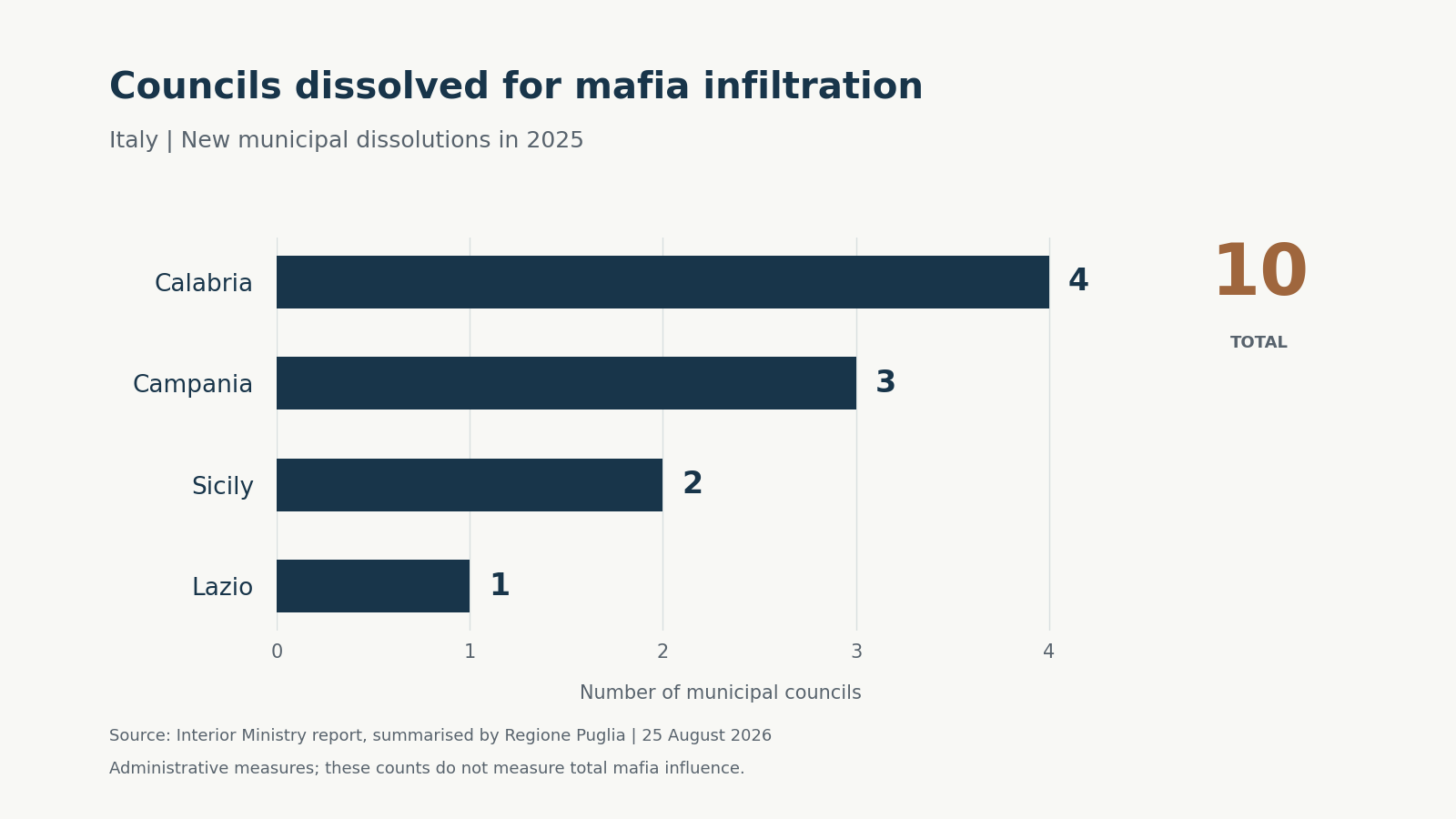
These interventions show why organised crime must also be examined as a governance problem. Public institutions decide how money is spent, services are provided and contracts are awarded. Their integrity directly affects citizens who have no involvement in criminal activity.
Responsibility cannot be confined to the moment a council is dissolved. The public deserves an account of what failed, which safeguards were ineffective and what changed afterwards. Replacing an administration without addressing the weaknesses that enabled infiltration risks leaving the underlying problem unresolved.
The cost extends beyond criminal profits
Economic research provides another reason to take business infiltration seriously. Paolo Pinotti's historical study estimated an approximately 16 percent GDP-per-person shortfall in Apulia and Basilicata against a constructed comparison. The sample ends in 2007. This is a model-based estimate of lost economic performance, not a current national mafia-income figure.
Source: Paolo Pinotti, Working Paper 868, Banca d'Italia research series, April 2012.
The distinction prevents a familiar mistake: confusing criminal revenue with the wider damage caused by organised crime. A community's loss includes opportunities that never develop, alongside offences that reach the courts.
ISTAT recorded 19 mafia-type homicides in Italy in 2024. That figure measures a particular category of killings. It cannot establish how many businesses were infiltrated, how much money was laundered or how many public decisions were compromised. Judging influence principally by visible bloodshed leaves other forms of harm outside the assessment.
Source: ISTAT, Homicide Victims 2024 report, 25 November 2025, page 7.
For legitimate businesses, fair competition requires enforceable rules and confidence that coercion will be punished. For citizens, public spending must serve public needs. Evaluating anti-mafia policy therefore requires attention to economic conditions and institutional trust as well as arrests and confiscations.
Has Western media ignored the problem?
Why does such a serious issue sometimes feel lost among other headlines? That concern deserves examination. The claim that Western media never report on Italian mafias does not survive checking.
Reuters has published reporting on the 'Ndrangheta. Associated Press covered the 2023 maxi-trial. The Guardian covered mafia-linked toxic waste in February 2025.
There is also direct testimony about the risks of reporting. At an Italian parliamentary hearing in February 2025, journalist Salvo Palazzolo described working under police protection in Palermo. His account illustrates why reporting on criminal influence requires more than occasional interest.
The more demanding question is whether public attention and editorial resources follow the financial, professional and institutional connections over time. How thoroughly are victims' experiences examined? Are the consequences of confiscations followed? Do investigations into official assistance remain visible after arrests leave the headlines?
This article does not establish a coordinated media cover-up or quantify how much coverage the subject receives. It does argue for sustained scrutiny. UNODC's finding that corruption connected to trafficking remains underreported provides a concrete reason to investigate gaps, rather than invent a universal silence.
Readers should expect persistence from journalism and transparency from authorities. Neither duty ends with the publication of an arrest photograph.
Accountability must survive the headlines
Italy's record also includes substantial resistance. The 1982 Rognoni-La Torre law established the specific mafia-association offence and strengthened asset measures. The Palermo maxi-trial began in 1986 and reached its first-instance judgment in 1987. Giovanni Falcone and Paolo Borsellino were murdered in 1992.
Those events demonstrate both the danger and the determination involved in confronting mafia power. Today's scrutiny must recognise the people who have fought it, including investigators, judges, journalists, business owners and citizens.
Libera Terra's work on confiscated property and Addiopizzo's support for businesses resisting extortion show forms of civic and economic action alongside prosecution. Criminal organisations must not become shorthand for Italian society.
The evidence demands a firm response. Pursue the trafficking networks. Trace their assets. Investigate the officials and intermediaries who knowingly assist them. Protect victims, witnesses and reporters. Explain institutional failures publicly, and demonstrate how safeguards improve.
This is not any single government's problem, but no government can use that fact to escape responsibility. A systemic failure crosses administrations; accountability must do the same. The proper test of progress is whether criminal networks lose the money, access and protection that allow them to rebuild. That work must continue long after the cameras leave.