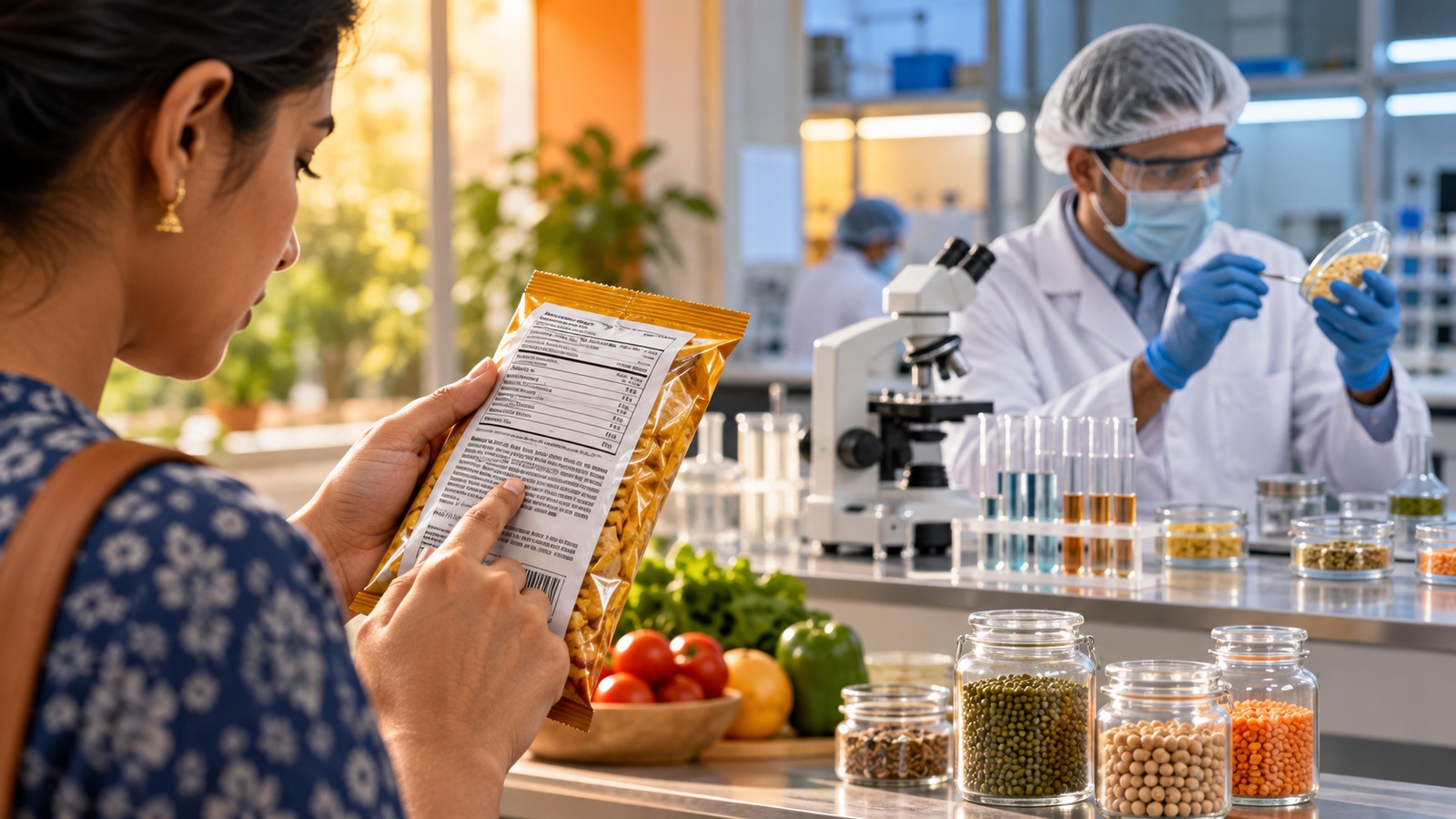
Turn over a packet of biscuits, a bottle of flavoured milk or a pouch of instant food and the ingredient panel may offer a small chemistry lesson: emulsifier, stabiliser, raising agent, preservative, followed by a name or an INS number. The disclosure may satisfy the rule. It does not necessarily answer the consumer’s question.
What is this substance doing in the food? How much of it is present? Is the same additive being consumed through several products in the same day? Has exposure been measured among Indian children, whose body weight and eating patterns differ from those of adults? If a safety review changes, where will the public see it?
These are not arguments for treating every additive as a threat. Preservatives can prevent dangerous microbial growth. Emulsifiers and stabilisers can keep food consistent through transport and storage. The World Health Organization says additives are assessed for possible harmful effects before approval, and that only specified uses and levels should be authorised. India’s regulations follow the same logic.
The policy problem begins after approval. A safety limit is meaningful only when a regulator can compare it with what people actually eat, check whether manufacturers remain within the permitted conditions, revisit older decisions when evidence changes, and explain the result in language the public can use.
India has built important parts of this system. It now needs to connect them. Project SAFE India — Surveillance and Assessment of Food-additive Exposure — should be the national framework that does so.
What Indian law already gets right
India is not starting from an unregulated market. FSSAI’s current standards say listed additives are suitable when used in conformity with the regulations and have either been assigned an acceptable daily intake or found safe on other grounds. The rules define the acceptable daily intake, or ADI, as the amount that can be consumed daily over a lifetime without appreciable health risk.
The same standards impose important conditions. An additive should provide a genuine technological advantage, should not mislead the consumer and should not disguise faulty raw materials or unhygienic practice. Under good manufacturing practice, the quantity should be limited to the lowest level needed to achieve its purpose.
Subject to specific provisions for flavours, carry-over additives and small packages, labels are generally supposed to identify additives by their functional class and specific name or International Numbering System number. India also has a statutory recall procedure, a consumer-grievance route through FoSCoS and a national network of notified and referral laboratories. In March 2026, FSSAI implemented a Food Recall function in FoSCoS through which authorities and food businesses record recalls and consumers can check recalled items.
The statutory mandate is wider than approval and enforcement. Section 16(3) of the Food Safety and Standards Act directs the Food Authority to collect and analyse data on food consumption and exposure, identify emerging risks, support a rapid-alert system and provide the public with rapid, reliable and comprehensive information. Project SAFE India would make those duties more visible and systematic for additives; it would not invent a new mandate.
That foundation deserves recognition. The central question is not whether a legal framework exists. It is whether the framework produces a sufficiently clear, continuous and public account of exposure and enforcement.
Table 1. India’s foundation — and the missing public layer
| Part of the system | What exists today | What Project SAFE India should add |
|---|---|---|
| Authorisation | Permitted additives, food categories, maximum-use levels and good-manufacturing-practice conditions | One searchable public record showing current status, permitted foods, limits, latest review and pending evidence gaps |
| Labelling | Functional class plus the additive’s specific name or INS number | A plain-language digital lookup, accessible by search or QR code, explaining purpose, permitted uses and review status |
| Exposure assessment | ADIs and maximum-use provisions are embedded in the standards | Recurring Indian dietary-exposure estimates, including children, high consumers and cumulative intake across food categories |
| Testing and inspection | State enforcement samples, risk-based inspections, notified laboratories and mobile units | A harmonised national additive-testing panel, comparable reporting categories and annual publication of results |
| Recall | Food Recall Procedure Regulations, 2017, and a FoSCoS Food Recall function made available in March 2026 | A complete, consistently populated public record with brand, batch, geography, reason, action required and closure status |
| Complaints | FoSCoS grievance tracking, including escalation when a response remains unsatisfactory after 15 days | End-to-end acknowledgement, triage and final-resolution standards, plus anonymised trend reporting |
Source note: FSSAI food-additive, labelling and recall regulations; Ministry of Health and Family Welfare statements. The third column contains the author’s recommendations.
Approval is not the end of the calculation
The ADI is often misunderstood. It is not a prediction that harm begins the moment a person crosses a line on one day. It is a health-based benchmark for daily intake over a lifetime, usually expressed per kilogram of body weight. It is therefore an exposure concept, not simply a property of the substance.
That distinction matters. A child and an adult may eat the same serving, but the child receives a larger dose per kilogram of body weight. A person may also encounter one additive in several products: a drink, confectionery, dessert and packaged snack. Measuring a single product against its legal limit does not by itself reveal total dietary exposure.
Codex, the international food-standards body created by FAO and WHO, says probable intake should consider all food sources and relevant consumer groups. The WHO also asks national authorities to monitor whether actual uses comply with permitted conditions. In other words, authorisation answers one question — whether a use can be safe under specified conditions. Surveillance answers another — whether those conditions reflect the market and the diet people have now.
India’s food market is changing quickly. Packaged foods reach deeper into small cities and rural retail. Quick-commerce and national distribution can scale a product rapidly. Reformulation can alter which additives are used and in what combinations. Exposure assumptions cannot remain static while the market changes around them.
A credible system therefore needs three live datasets: what products contain, how much people eat and what laboratories find. Project SAFE India should join them without publishing commercially sensitive formulas. Manufacturers can report actual-use ranges by food category; dietary surveys can show consumption by age and region; laboratories can verify whether products stay within permitted conditions. The public result should be an exposure estimate, the uncertainty around it and the regulatory response.
There are signs that the technical base is being strengthened. In January 2026, FSSAI launched a WHO-supported national training programme in food-safety risk assessment. Its curriculum includes dietary-exposure methods, food-consumption data, chemical-occurrence data and the use of international assessment tools. This is a valuable capacity-building step. It is not yet the recurring, public Indian exposure dataset proposed here, but it shows that the institutional groundwork has begun.
What the enforcement numbers say — and what they do not
Official data show a large enforcement effort. Between 2020–21 and 2025–26, States and Union Territories analysed 994,541 food samples and reported 214,127 as non-conforming. The latest year is provisional: in 2025–26, 223,808 samples were analysed and 40,023 were reported non-conforming, subject to revision as further laboratory testing and court proceedings are completed.
Those figures must be read carefully. Enforcement samples are not a nationally representative basket of everything Indians buy. Authorities may target high-risk categories, suspicious businesses, complaints or seasonal risks. “Non-conforming” is also broader than “unsafe”: it can cover substandard products, labelling defects, misleading claims and other breaches as well as food-safety failures.
It would therefore be wrong to say that nearly one in five foods sold in India failed in 2025–26. The defensible statement is narrower: about 17.9 per cent of the samples selected and analysed by enforcement authorities that year were provisionally reported as non-conforming. That is still important. It tells us the control system is finding breaches, but not which share relates specifically to additives, which additives are involved or what consumers should do next.
Figure 1. Food samples analysed and reported non-conforming, 2020–21 to 2025–26
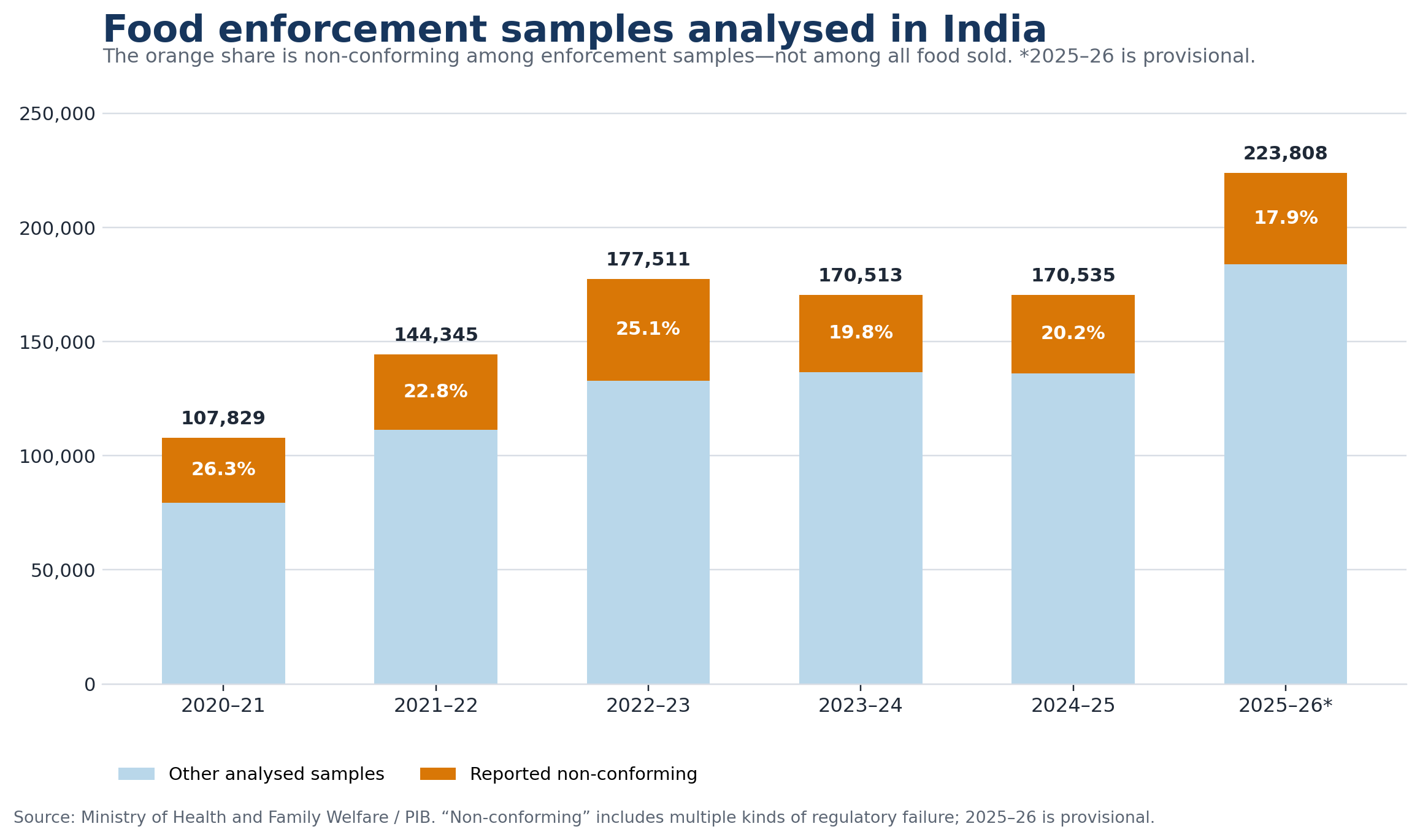
Source: Ministry of Health and Family Welfare/PIB. The chart covers enforcement samples, not a representative survey of all food sold. “Non-conforming” is not synonymous with “unsafe”. The 2025–26 figures are provisional. Percentages are the author’s calculations from official totals.
The inspection network is expanding. FSSAI reported 11,904 risk-based inspections in 2022–23, 18,098 in 2023–24 and 26,267 in 2024–25 — a 121 per cent increase over two years. By August 2026, the government reported a notified network of 259 NABL-accredited food-testing laboratories, 24 referral laboratories and 305 mobile Food Safety on Wheels units. The notified total should not be read as proof that every laboratory held currently valid accreditation on the research cut-off date.
In September 2026, FSSAI notified amendments to the Laboratory and Sample Analysis Regulations, effective 1 April 2027, covering analysis methods, reporting formats and timelines. More consistent laboratory procedure should improve enforcement. It still does not answer the exposure question by itself: a faster, standardised test report is not the same as a population-level estimate of how much of an additive different groups consume.
Figure 2. Risk-based food inspections more than doubled in two years

Source: Ministry of Health and Family Welfare, Lok Sabha reply published by PIB on 13 March 2026. Inspection counts measure regulatory activity, not the prevalence of unsafe food.
This is meaningful capacity. Yet more inspections do not automatically create better public knowledge. For additives, the reporting should say which substances and food categories were tested, which analytical methods were used, how many results exceeded a legal limit, whether the issue was unauthorised use or excess use, which age groups could be most exposed, and what corrective action followed.
Without those distinctions, one national “non-conforming” total carries too many different stories.
Transparency is part of the safety system
Other regulators are not perfect, but their public tools show what a more connected system can look like.
The European Commission operates a searchable database of additives approved in the European Union and their conditions of use. EFSA maintains a comprehensive food-consumption database that supports exposure estimates by country, food group and age, including infants and older adults. It also publishes additive re-evaluations and explains when data are insufficient, an ADI changes or estimated exposure may exceed it for a population group. The EU’s RASFF system adds a searchable window for food-safety notifications and a consumer portal for recalls.
The United States takes a different legal approach, including the GRAS category, but it also offers useful transparency mechanisms. The FDA’s public Substances Added to Food inventory contains nearly 4,000 records, while a separate table identifies selected chemicals under review, the stage of review and recent risk-management action. In 2026, the FDA finalised a systematic post-market assessment process and launched reassessments of BHA, BHT and azodicarbonamide. As of 25 September, GRAS notification remained voluntary, although FDA had proposed mandatory notices for certain uses in August; that proposal was not yet final. FDA recall announcements cover selected recent cases, while separate Enforcement Reports provide the broader record of FDA-monitored recalls.
These systems also reveal their own limits. The FDA says its ingredient inventory is only partial and acknowledges that post-market use information can be incomplete. EFSA has at times been unable to conclude a re-evaluation because relevant data were missing. Transparency does not eliminate uncertainty. It makes the uncertainty visible and creates pressure to close it.
Table 2. Public tools India can adapt, not simply copy
| Public benchmark | What it makes visible | Practical lesson for India |
|---|---|---|
| EU additives database | Approved additives and conditions of use | Put the legal answer in one searchable consumer and industry interface |
| EFSA consumption database and exposure tools | Consumption by food group, age and population; exposure estimates | Build India-specific, child-sensitive exposure models rather than relying only on legal maximums |
| EFSA re-evaluations | Evidence considered, revised ADIs, data gaps and population concerns | Publish a rolling review calendar and the reason for each regulatory conclusion |
| EU RASFF consumer portal | Recent recalls and public-health warnings | Build the existing FoSCoS recall function into a complete, consistently populated alert record |
| FDA substances inventory and review list | Ingredient status, technical use and chemicals under active review | Separate “permitted” from “currently under review” and show the stage of work |
| FDA recall announcements and Enforcement Reports | Recent public announcements plus the broader record of FDA-monitored recalls | Standardise recall notices and keep an accessible archive |
Source note: European Commission, EFSA and US FDA public databases and programme pages, accessed September 2026.
Project SAFE India
Project SAFE India should be designed as a permanent regulatory programme, not a one-time survey or awareness campaign. Its purpose would be to answer a simple national question: are actual exposures to permitted additives within health-based limits for the people who consume the most?
Seven components are essential.
First, a national food-additive register. Every permitted additive should have a public page with its common name, INS number, function, allowed food categories, maximum level or GMP status, ADI where applicable, latest review date, evidence status and links to the controlling regulation. Amendments should update the page automatically.
Second, recurring dietary-exposure studies. India needs a representative programme that combines food-consumption data with measured or reported additive concentrations. Results should be published for infants, children, adolescents and adults, with attention to high consumers and major regional dietary patterns. A national average can conceal the very group for whom exposure matters most.
Third, a priority testing panel. FSSAI introduced a National Annual Surveillance Plan in 2023–24; Project SAFE India should add an additive-specific layer within that system rather than create a parallel sampling programme. Laboratories should use a common, risk-ranked list based on consumption, toxicological concern, history of non-compliance and exposure uncertainty. The panel should distinguish unauthorised use, use above the maximum level, identity or purity failures and label mismatches. Results should be comparable across States.
Fourth, structured post-market review. Approval should not become permanent by inertia. New toxicology, changing use levels, higher consumption or international regulatory action should be valid triggers for review. A published annual work plan should identify which additives are being screened, assessed or managed, without implying that review itself proves danger.
Fifth, a stronger national recall and alert service. India’s 2017 regulations define recall duties and communication, and FSSAI implemented Food Recall functionality in FoSCoS in March 2026. Project SAFE India should build on that system rather than duplicate it. Every material recall should use consistent fields for product, brand, batch, location, reason, date, consumer action and status, and the public record should remain searchable through closure. A notice should tell a consumer exactly what to check and whether to discard, return or avoid the product.
Sixth, labels that lead somewhere. The printed ingredient list should remain the legal record. A voluntary digital layer can add the explanation that cannot fit on a small pack. Searching an INS number — or scanning a standard QR link — should open the official register, not a marketing page. The language must remain factual: what the additive does, where it is permitted and when it was last reviewed.
Seventh, an independent annual report. FSSAI should publish an annual additive-exposure and compliance report reviewed by an external scientific committee. It should state methods, sampling limitations, missing data and corrective actions. Parliament should receive the same report so that surveillance becomes an accountable public function rather than a collection of disconnected exercises.
A practical 2027–2030 timetable
The framework can be built in stages. It does not require every laboratory to test every additive or every package to carry a new warning. It requires a common data architecture and priorities that can be defended.
Table 3. Proposed delivery plan for Project SAFE India
| Period | Government action | Public output |
|---|---|---|
| 2027 | Establish the SAFE unit; publish data standards; convert permitted-use schedules into a searchable register; identify the first priority additives and food categories | Beta national register, review calendar and testing protocol |
| 2028 | Run consumption and market-concentration studies in representative regions; validate methods across notified labs; pilot child-specific exposure assessment | First pilot exposure report with uncertainty ranges and methods |
| 2029 | Expand to all States/UTs; connect FoSCoS complaints, laboratory findings and the existing Food Recall function; require structured use-range reporting for priority additives | National dashboard, enhanced searchable recall and alert record, and State-comparable reporting |
| 2030 | Publish the first full national assessment; evaluate the programme independently; revise limits, conditions or surveillance priorities where evidence requires | Annual SAFE report to Parliament and a time-bound corrective-action tracker |
This is the author’s proposed implementation sequence.
The metrics should reward knowledge and response, not raw enforcement alone. Useful measures include the share of permitted additives with a current public record; the share of priority additives covered by validated test methods; the proportion of exposure estimates reported separately for children; the time between a confirmed risk and a public alert; recall retrieval rates; and the number of reviews completed with a published rationale.
A rising inspection count can be encouraging. A falling failure rate can be encouraging. Neither is enough without knowing whether the right products were tested and the most exposed groups were assessed.
What consumers should — and should not — be told
Consumers deserve clarity, but not alarmism.
They should be told that a permitted additive has a function and conditions of use. They should be able to identify it, find the official record and see whether its status is current. If a product breaches the rule, the notice should explain whether the problem is unauthorised use, excess quantity, purity, mislabelling or another defect.
They should not be encouraged to read every unfamiliar chemical name as proof of harm. “Natural” is not an automatic safety guarantee, and “synthetic” is not an automatic danger signal. Nor should a product be treated as nutritionally desirable simply because it contains no additive. Additive safety, overall nutritional quality and the degree of processing are related policy questions, but they are not interchangeable.
That is why Project SAFE India should not create a simplistic red-or-green score for individual additives. It should publish the evidence, the permitted conditions, the estimated exposure and the regulatory conclusion. Where uncertainty remains, it should say what data are missing and when the question will be revisited.
The confidence test
India’s food-additive rules contain the right principle: a substance should be used only when it has a legitimate purpose, does not present an appreciable health risk, does not mislead the consumer and is limited to what is needed. The next step is to demonstrate, continuously and publicly, that those conditions hold in the real market.
The country has regulatory standards, enforcement powers, laboratories, inspectors, complaint channels and recall law. Project SAFE India would not replace them. It would make them operate as one visible system.
The most useful answer to public concern is neither “all additives are safe” nor “all additives are harmful.” It is a record that shows which use was assessed, what Indians are estimated to consume, where compliance failed, what changed after new evidence and how quickly consumers were informed.
India is regulating food additives. The question raised by the packet in a consumer’s hand is whether the country is measuring and explaining enough. By 2030, it should be able to answer with evidence.