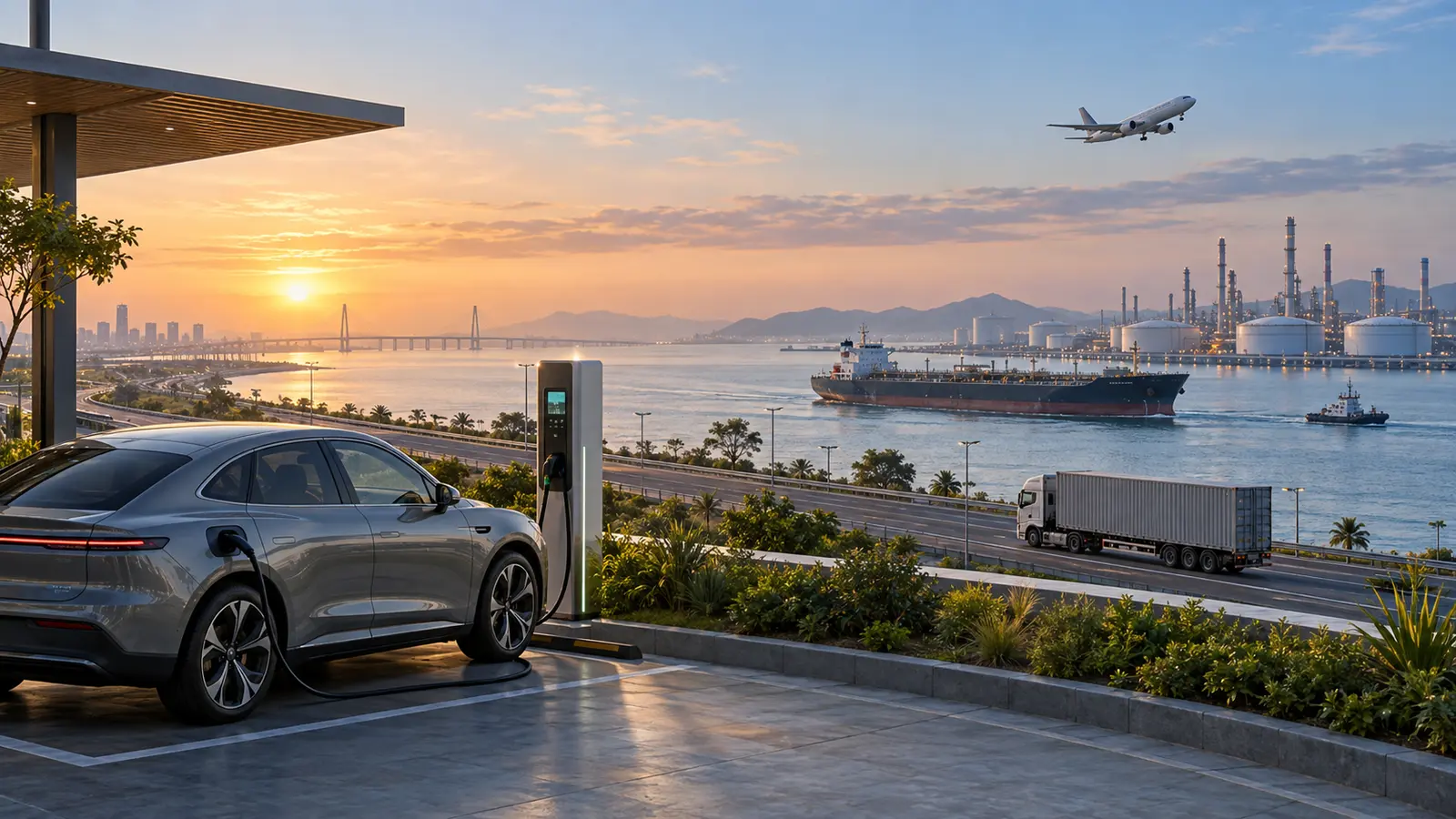
On Indian roads, the electric transition no longer looks like a distant promise. E-rickshaws have become ordinary urban transport. Electric scooters are visible well beyond the largest cities. Fleet operators are paying attention to running costs, and buyers who once worried first about range now ask about charging time, resale value and service support. The conversation has moved from whether electric vehicles will arrive to how quickly the market can absorb them.
The numbers bear this out. India registered 459,000 electric vehicles in FY2021-22. By FY2025-26, annual registrations were close to 2.5 million, according to NITI Aayog. Electric vehicles accounted for 8.25 per cent of new registrations and more than 8.7 million were on Indian roads. The change has been led mainly by two- and three-wheelers, rather than private cars, but that does not make it less significant. Those are the vehicles that carry millions of people and goods through Indian cities every day.
I have no interest in talking down this achievement. Anyone who still treats electric mobility as a fashionable sideshow is reading an old market. Yet a second claim has travelled alongside the EV boom: once electric cars take over, the age of oil will be almost finished. That conclusion moves far ahead of the evidence. Passenger cars are only one user of a barrel, and new vehicles replace the existing fleet slowly. Aviation, freight, shipping, chemicals and defence operate under very different technical and strategic constraints.
The useful question is therefore not whether EVs work. They do. It is how much oil they can displace, how quickly they can do it, and which forms of oil demand will remain after road transport changes. Once those questions are separated, the apparent fight between electric vehicles and oil largely disappears.
Five years that changed the car market
Global electric-car sales rose from about 6.5 million in 2021 to 20.9 million in 2025. The International Energy Agency now puts electric cars at one-quarter of all new cars sold worldwide. China drove much of the expansion, Europe returned to growth in 2025, and new markets across Asia, Latin America and the Middle East began to matter. This is no longer a transition confined to Norway, California or a small class of wealthy consumers.
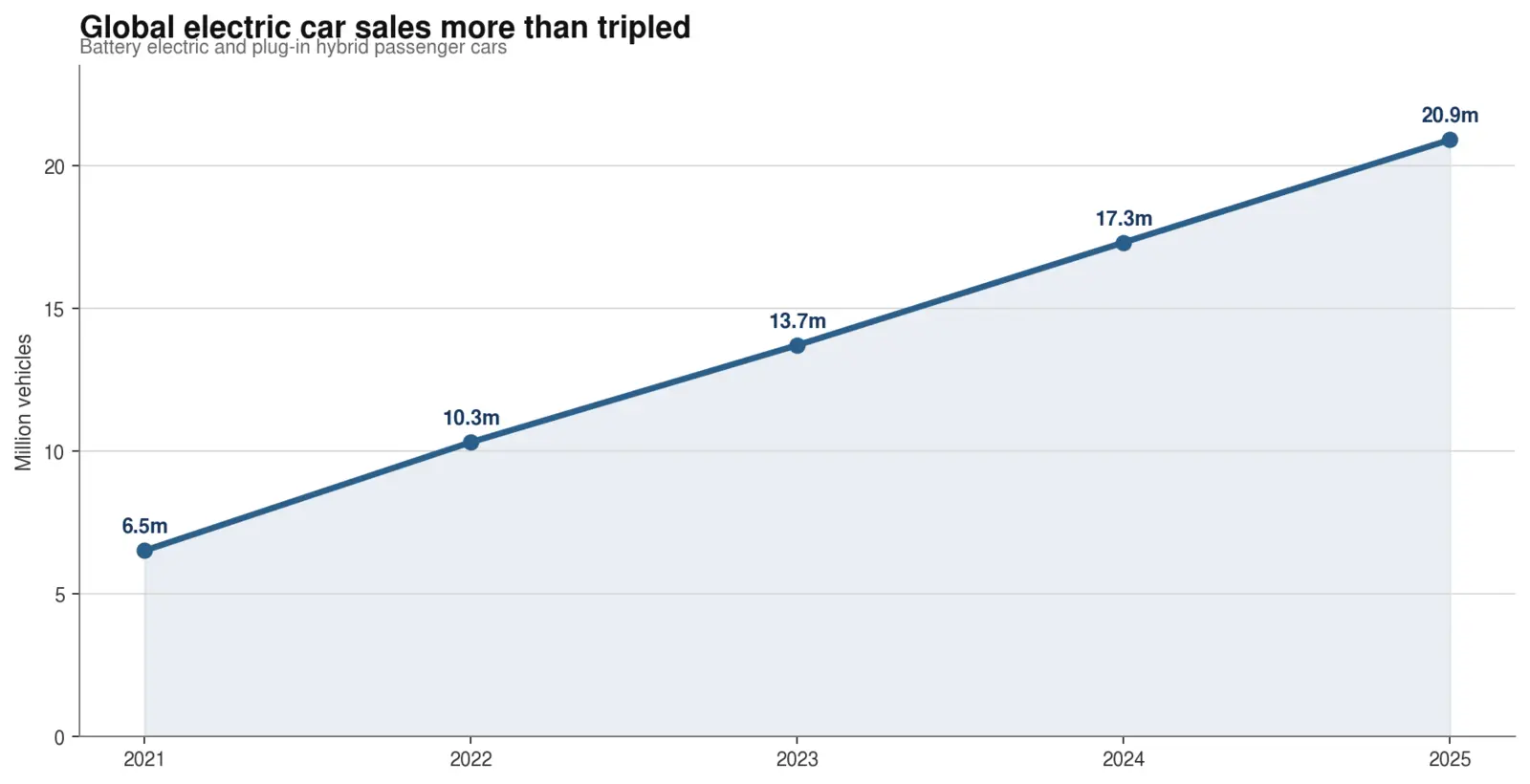
Source: International Energy Agency, Global EV Outlook 2026. Totals are derived from the IEA regional chart and are rounded.
Sales growth of that scale must reduce fuel use. The IEA estimates that electric cars alone displaced about 1.2 million barrels a day of oil in 2025. When electric two- and three-wheelers, buses and trucks are included, the displacement rises to roughly 1.7 million barrels a day. Under current policies, the figure could reach around 5 million barrels a day by 2030. Those are material savings, especially for import-dependent economies.
During the same five years, however, world consumption of petroleum and other liquid fuels increased from about 97.4 million barrels a day to 104.3 million. The annual rate of growth slowed, but the level kept rising. The latest U.S. Energy Information Administration series shows a 7 per cent increase between 2021 and 2025.
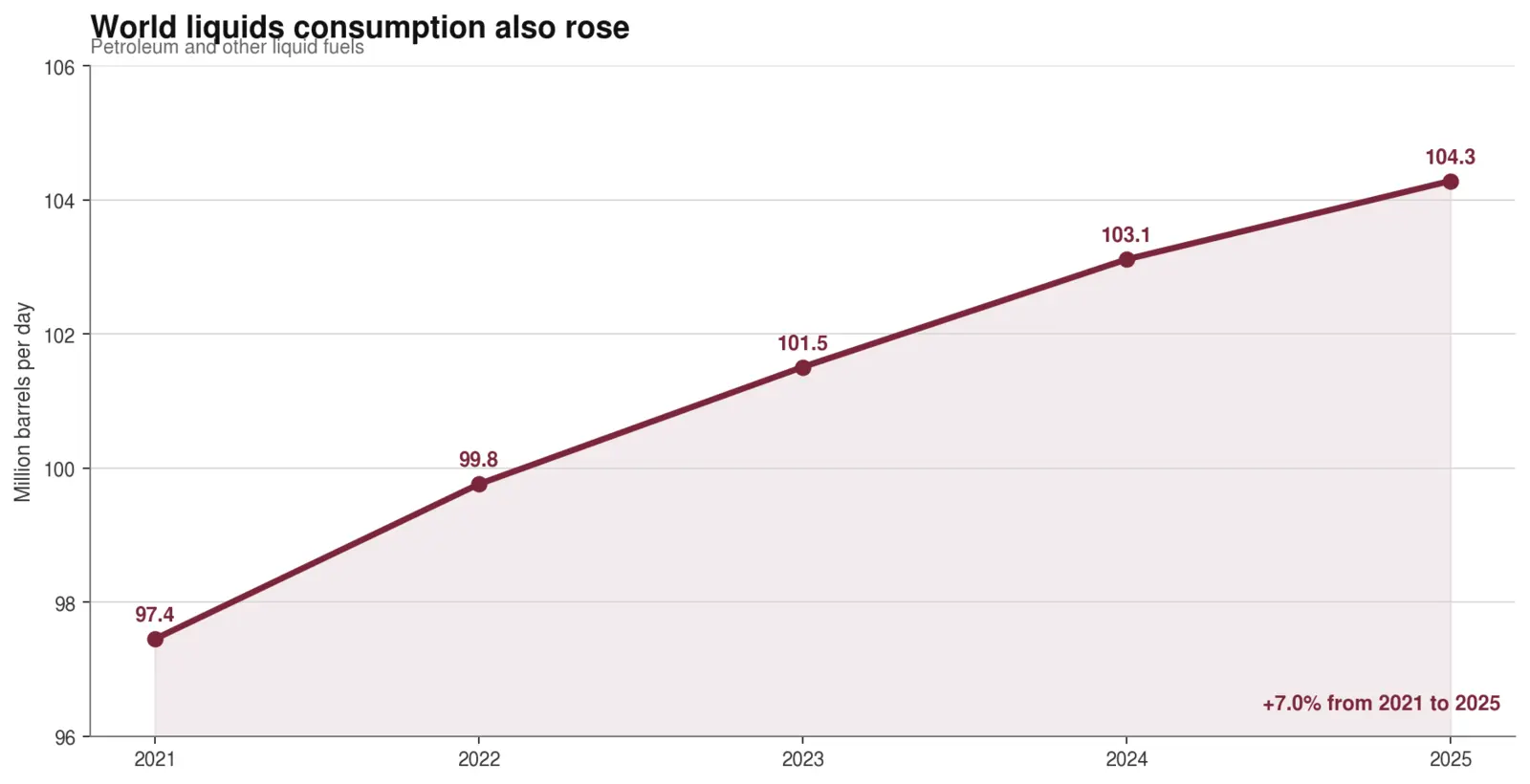
Source: U.S. Energy Information Administration. The 2021-2024 values use the latest International Energy Statistics series; 2025 uses the September 2026 Short-Term Energy Outlook.
| Year | Global electric car sales | EV sales YoY | World liquids consumption | Oil YoY |
|---|---|---|---|---|
| 2021 | 6.5 million | - | 97.4 mb/d | - |
| 2022 | 10.3 million | +58.5% | 99.8 mb/d | +2.4% |
| 2023 | 13.7 million | +33.0% | 101.5 mb/d | +1.8% |
| 2024 | 17.3 million | +26.3% | 103.1 mb/d | +1.6% |
| 2025 | 20.9 million | +20.8% | 104.3 mb/d | +1.1% |
Sources: IEA Global EV Outlook 2026; U.S. EIA International Energy Statistics and September 2026 Short-Term Energy Outlook. Percentages are calculated from the displayed values.
These lines do not cancel each other out. The oil market is a counterfactual market: demand is lower than it would have been without EVs, even if total consumption still rises. Population, income, freight activity, air travel, industrial production and petrochemical use can add more demand than electric vehicles remove. It is entirely possible for electrification to succeed while the world still consumes more oil.
There is another reason to be patient with the data. New-car sales change the fleet only one year at a time. Electric models accounted for about 25 per cent of sales in 2025, but only around 5 per cent of the global passenger-car stock was electric. Petrol and diesel vehicles already on the road will remain in service for years. A sales revolution arrives long before a fleet revolution.
India is living the paradox already
India makes the relationship unusually clear. EV registrations increased more than fivefold from FY2021-22 to FY2025-26. Central schemes, state policies, battery manufacturing, lower running costs and a rapidly expanding charging network all helped. NITI Aayog reports that public charging stations rose from about 5,151 in December 2022 to more than 29,000 by June 2025.
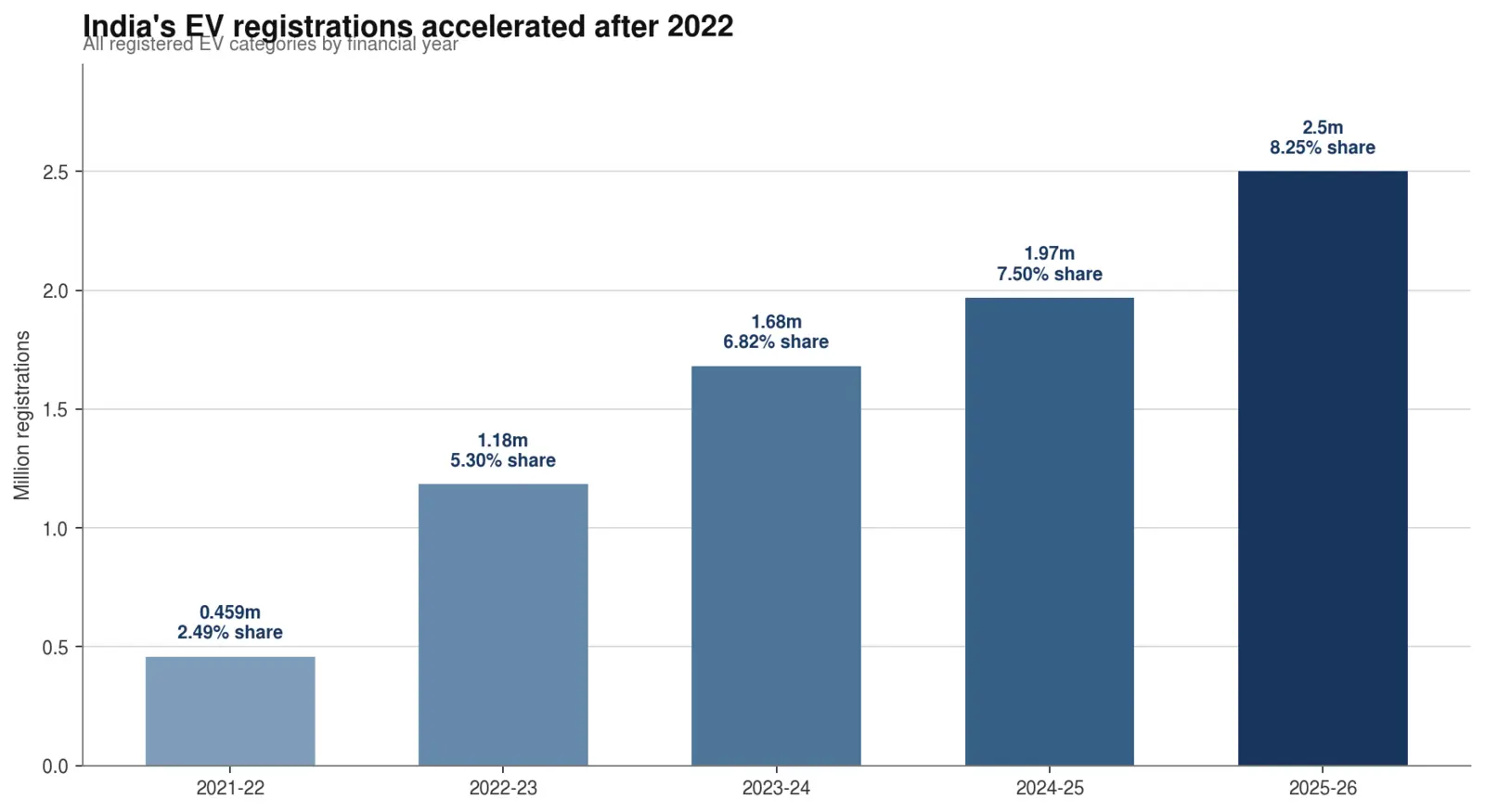
Sources: Ministry of Heavy Industries and Vahan through FY2024-25; NITI Aayog India Electric Mobility Index 2025 for FY2025-26. The latest registration figure is reported as close to 2.5 million.
Oil demand is also rising. In its India Oil Market Report, the IEA projected consumption increasing from about 5.4 million barrels a day in 2023 to 6.6 million by 2030. India would supply more than one-third of the global increase in that medium-term outlook. Freight, industrialisation, aviation, tourism, petrochemicals and greater personal mobility all push in the same direction.
The figure that matters most is 480,000 barrels a day. That is the additional Indian demand the IEA expects EV deployment and efficiency improvements to avoid by 2030. Oil consumption still rises in the forecast, but it would rise much more without electrification. India is not choosing between an EV economy and an oil economy. It is reducing the oil intensity of growth while the underlying economy expands.
What one electric vehicle removes from the fuel bill
National totals can make the benefit feel abstract, so it helps to bring the calculation down to one vehicle. NITI Aayog's transport modelling uses annual-distance and efficiency assumptions for common Indian vehicle types. On those assumptions, an electric passenger car replacing a petrol car avoids roughly 767 litres of petrol a year. An electric two-wheeler avoids about 144 litres. A heavily used commercial three-wheeler can avoid more than 1,000 litres when it replaces a petrol vehicle.
| Vehicle replaced | Annual distance | Conventional efficiency | Fuel avoided each year |
|---|---|---|---|
| Passenger car | 11,500 km | 15 km per litre petrol | About 767 litres petrol |
| Two-wheeler | 7,500 km | 52 km per litre petrol | About 144 litres petrol |
| Commercial three-wheeler | 25,915 km | 25 km per litre petrol | About 1,037 litres petrol |
Illustration using NITI Aayog 2026 transport-scenario assumptions. Actual results vary with distance, traffic, vehicle condition and driving style.
The third row needs a caveat. Many Indian auto-rickshaws run on CNG. Replacing one of them reduces natural-gas use, not petroleum use. Counting every electric three-wheeler as identical oil displacement would inflate the result. The same discipline should apply throughout the EV debate: credit the technology for what it genuinely saves, and keep unlike fuels separate.
These calculations cover operation, not the full lifecycle. Battery production, the source of electricity, charging losses and vehicle retirement determine the emissions outcome. For oil security, however, the immediate point is simpler. A litre of petrol that is no longer burned is a litre India does not need to import, refine, transport or subsidise against a future shock.
A barrel has more than one customer
Popular discussion often treats oil as though it were another name for petrol. A refinery barrel serves a much wider economy. It supplies diesel, jet fuel, marine fuels, lubricants, bitumen and feedstocks for chemical production. Electrifying the family car puts pressure on an important part of the barrel, but it does not replace the whole barrel.
Heavy trucks show how uneven the change will be. More than 400,000 electric trucks were sold worldwide in 2025, about 9 per cent of truck sales, with China accounting for more than 90 per cent of the market. Batteries already suit ports, mines and fixed regional routes. Long-haul work with heavy payloads and uncertain charging access will take longer, as will replacement of the installed diesel fleet.
Aviation is harder. Batteries carry far less usable energy per kilogram than jet fuel, which limits direct electrification of long-haul flight. Sustainable and synthetic aviation fuels may reduce crude-oil dependence, but aircraft will still need dense, transportable liquids. Even in the IEA's Stated Policies Scenario, aviation oil use continues to increase through 2050.
Shipping will use efficiency, batteries on short routes, biofuels, methanol, ammonia and other alternatives. Deep-sea vessels last for decades, bunkering networks span continents and new fuels must work at sea, not only in a laboratory.
Petrochemicals are the largest blind spot. Oil becomes polymers, synthetic fibres, coatings and solvents used across packaging, construction, medicine and manufacturing. The IEA expects polymers and synthetic fibres to require 18.4 million barrels a day by 2030, more than one barrel in six, and sees petrochemicals as the largest source of oil-demand growth from 2026. Recycling and material substitution can moderate that demand, but they follow a different path from vehicle electrification.
Defence changes the meaning of energy security
Defence planners value energy that can be stored, moved and used under pressure. Air forces, naval operations, armoured units and expeditionary logistics need high energy density and mature supply systems. Batteries will serve sensors, bases, drones and some tactical vehicles. Nuclear propulsion already serves a narrow class of ships, while synthetic and bio-derived fuels may take a larger share. The liquid-fuel requirement remains.
NATO's infrastructure shows the scale involved. Its petroleum system extends roughly 10,000 kilometres through 12 countries and holds 4.1 million cubic metres of storage. It connects refineries, depots, airfields, airports and transport loading points. Countries maintain such systems because assured fuel supply is part of military readiness.
Military fuel can change in composition. The need for a reliable liquid-fuel chain will outlast the internal-combustion engine's dominance of private cars. India, with continental borders, a large coastline and long supply lines, cannot ignore that distinction.
The 2050 debate is about volume
Long-range forecasts are often quoted as verdicts. They are better read as conditional maps. Change the policy assumptions, technology costs, economic growth or consumer behaviour and the destination moves. The spread between the leading outlooks is unusually wide.
| Institution and scenario | Oil demand outlook | Main reason |
|---|---|---|
| IEA Stated Policies Scenario | Peaks near 102 mb/d around 2030, then gradually declines | Faster EV uptake and efficiency; aviation and petrochemical use still rises to 2050 |
| IEA Current Policies Scenario | Reaches 113 mb/d in 2050 | Slower EV uptake; stronger mobility, aviation and petrochemical demand |
| OPEC World Oil Outlook 2026 | Reaches 124 mb/d in 2050 | Faster emerging-market growth and slower substitution |
Sources: IEA World Energy Outlook 2025 and OPEC World Oil Outlook 2026. These are scenarios based on different assumptions, not directly interchangeable forecasts.
The institutions arrive at very different numbers. OPEC represents producer countries and has an obvious interest in long-term oil demand. The IEA's scenarios also depend on policy and technology judgements that can change. The sensible response is not to pick the number that flatters one's preference. It is to identify what every serious outlook still has to explain: in 2050 the world is using oil in large quantities, even where the total has begun to decline.
A peak is a turning point, not an extinction event. Demand can peak above 100 million barrels a day and remain a vast market for many years. The geopolitical consequences may even become sharper if production and spare capacity concentrate in fewer countries while investment elsewhere falls.
The forty years of oil left is not a countdown
The familiar claim that the world has roughly forty years of oil remaining usually comes from dividing proved reserves by one year's production. That ratio is useful as a snapshot. It is misleading when presented as an expiry date.
The EIA defines proved reserves as oil in known reservoirs that can be recovered with reasonable certainty under existing economic and operating conditions. Prices change. Technology improves. Drilling extends known fields. Better data reclassify resources. New discoveries add to the ledger, while production subtracts from it. Proved reserves are therefore an economic and engineering category, not a survey of every molecule underground.
There is room for further discovery. A U.S. Geological Survey assessment published in 2025 estimated a mean 1 billion barrels of undiscovered, technically recoverable conventional oil across India and Sri Lanka. That is geological potential, not a booked reserve or a promise of commercial production. Larger discoveries elsewhere are possible. No responsible analysis can guarantee that a future field will shock the world, and energy policy should not depend on one.
The more immediate supply problem is decline. The IEA estimates that output from existing oil fields falls by about 8 per cent a year if investment stops. Its 2025 outlook requires roughly 20 million barrels a day of new supply from projects not yet approved by 2035 in the Stated Policies Scenario, and about 25 million in the Current Policies Scenario. Even a world approaching peak demand must replace depleted production.
This creates an uncomfortable policy balance. Excess investment can leave expensive assets underused. Too little investment, withdrawn before alternatives are ready, can produce shortages and price shocks. The transition will be damaged if households come to associate it with unreliable supply and sudden inflation.
India needs two policies at the same time
India should accelerate electric mobility. The biggest early gains lie in high-mileage two- and three-wheelers, buses, delivery fleets and urban vehicles. Charging must become easier, distribution grids stronger and battery recycling credible. Rail, public transport, fuel efficiency and biofuels can reduce oil exposure further. Every barrel avoided helps the trade balance and gives India more room when prices rise.
India must also prepare to remain a major oil importer for decades. In its 2024 market report, the IEA found that domestic production met only about 13 per cent of India's needs in 2023. It projected crude imports rising from 4.6 million barrels a day in 2023 to 5.8 million by 2030. On the agency's methodology, total stocks then covered about 66 days of net imports, while dedicated strategic reserves amounted to roughly seven days.
That dependence calls for deeper strategic storage, a wider supplier base, resilient ports and pipelines, capable refineries and practiced contingency plans. The Strait of Hormuz, the Strait of Malacca and other maritime routes will remain national-security concerns even as electric-car sales rise. An importing country cannot treat oil security as yesterday's problem while it is still building tomorrow's transport system.
Producer countries face the reverse challenge. Saudi Arabia and other large exporters should not read persistent oil demand as protection from technological change. EVs are already taking measurable demand out of road transport. Gasoline will face more pressure than aviation fuel or petrochemical feedstocks. Low production costs, reliable supply, efficient refining, stronger downstream industries and economic diversification will decide which producers remain influential.
The United States and Britain have their own lesson. Cutting oil demand can improve security and reduce emissions. Retiring fuel infrastructure before replacement systems are mature can create a different vulnerability. Resilience requires an orderly reduction in dependence, supported by electricity networks, storage, alternative fuels and realistic plans for the uses that are hardest to electrify.
Electric vehicles are among the most useful tools available to an oil-importing country. Their success should be measured in fuel avoided, cleaner urban air and reduced exposure to external shocks. It does not need to be exaggerated into a claim that oil is about to disappear.
By 2050, petrol may have lost much of its hold on passenger mobility. Oil demand may be lower than today's level, broadly flat or still growing, depending on policy and technology. In every case, the market will look different: less centred on the private car, more dependent on aviation, chemicals, freight and strategic uses, and possibly more concentrated in a smaller group of competitive producers.
The sound policy is to electrify wherever electricity works better and to secure the fuels that cannot yet be replaced at scale. India has no reason to choose one side of that equation. It needs both, on different timelines and for different parts of the economy.