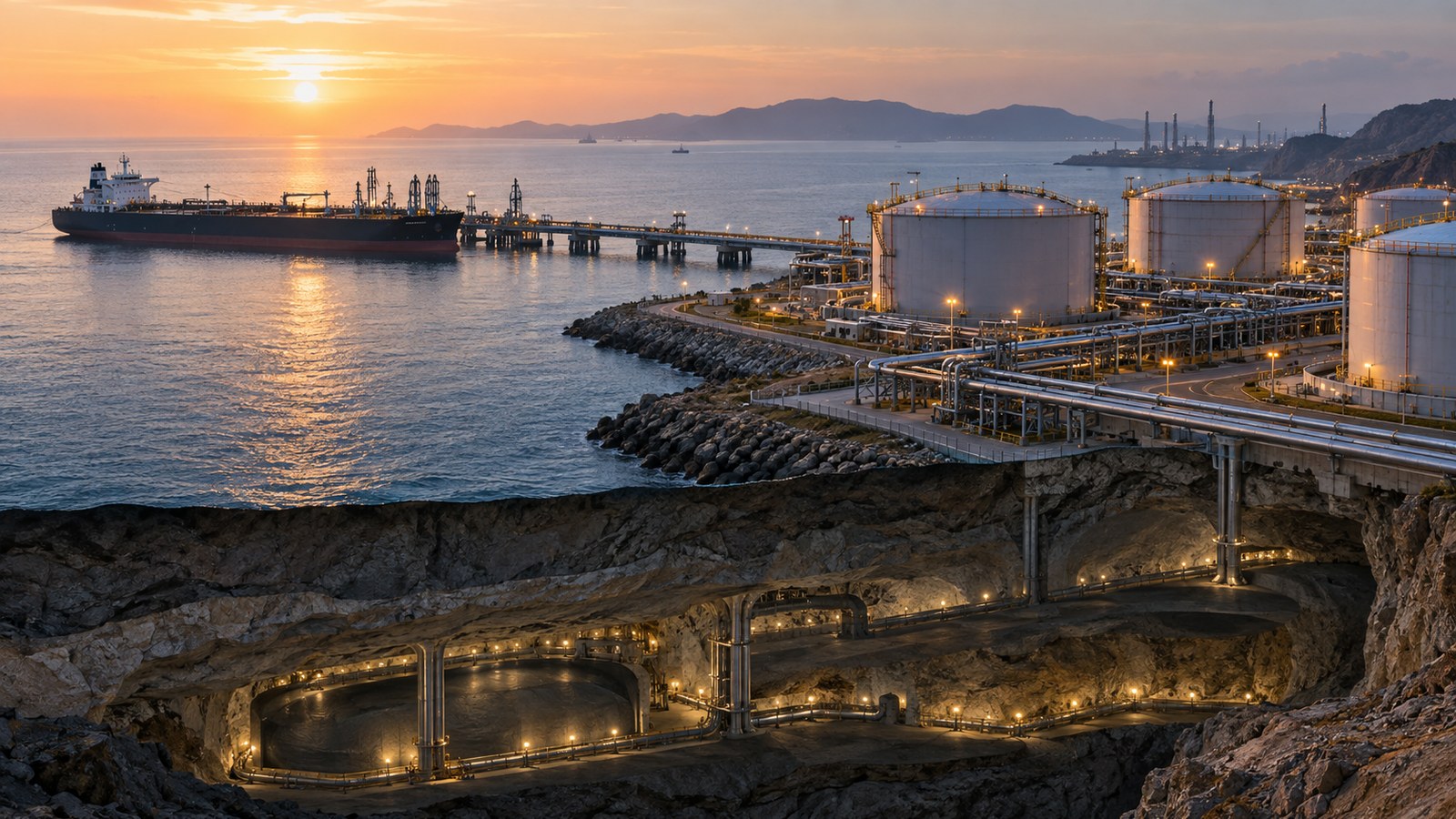
In March 2026, a severe disruption in the Middle East reduced oil flows through the Strait of Hormuz to less than one-tenth of their pre-conflict level. The International Energy Agency responded with the largest coordinated stock release in its history: 400 million barrels. Tankers, pipelines and diplomacy still mattered, but stored oil gave importing countries something more valuable than a headline intervention. It gave them time.
India should read that episode as a warning. Nearly nine-tenths of the crude processed by its economy now comes from abroad. A disruption can reach far beyond the fuel pump. Refineries need feedstock, airlines need jet fuel, farms and freight networks need diesel, the armed forces need assured supplies, and petrochemical plants need continuous inputs. A prolonged shortage would raise transport costs, strain the rupee, complicate inflation management and force hard allocation decisions across the economy.
Strategic storage cannot make imported oil cheap, and it cannot replace diversified suppliers, ports or pipelines. Its purpose is narrower and more practical. It bridges the first weeks of a physical disruption while alternative cargoes are arranged, demand is restrained and the government decides which users must be protected. India has built this first line of defence, but the sanctioned programme remains too small for the scale of the economy it is expected to protect.
The reserve India did not have in 2014
The clean historical answer is easy to miss. India had no operational, dedicated strategic petroleum reserve in 2014. A government statement issued in July that year said 5.33 million metric tonnes of underground capacity was being developed at Visakhapatnam, Mangaluru and Padur. The first site, Visakhapatnam, was commissioned only in June 2015. Mangaluru followed in October 2016 and Padur in December 2018.
The programme itself was older. Indian Strategic Petroleum Reserves Limited was created in 2004, and construction crossed several governments. The relevant comparison is therefore between a plan and an operating system, not between two political slogans. In 2014 the caverns were an infrastructure project. By the end of 2018 they had become usable national assets. That progress established the physical foundation on which a larger Viksit Bharat reserve can now be built.
The original arithmetic also needs context. In 2014, officials said the planned 5.33 million tonnes would cover roughly 13 days of net imports. The same physical volume represents fewer days now because India consumes and imports more oil. Using Petroleum Planning and Analysis Cell data for FY2025-26, when crude imports were about 245.8 million tonnes, 5.33 million tonnes equals about 7.9 days of imports. The cavern did not shrink; the denominator grew.
Table 1 What India had, has and has formally approved
| Reference point | Operational or sanctioned position | Capacity detail | What it means |
|---|---|---|---|
| 2014 | 0 MMT operational | 5.33 MMT under construction | First facility commissioned in June 2015 |
| Current, September 2026 | 5.33 MMT operational | Visakhapatnam 1.33; Mangaluru 1.50; Padur I 2.50 | About 7.9 days of FY2025-26 crude imports |
| Approved Phase II | +6.50 MMT | Padur II 2.50; Chandikhol 4.00 | Total would reach 11.83 MMT when both are built |
| 2030 | No separate sanctioned target | 11.83 MMT is the approved ceiling if Phase II is delivered | About 15 days at the IEA's projected 2030 import rate |
| 2047 | No sanctioned SPR tonnage found | Viksit Bharat scenarios do not prescribe a storage volume | A rolling days-based obligation is proposed in this article |
Sources: Ministry of Petroleum and Natural Gas and PIB statements; ISPRL; Lok Sabha and Rajya Sabha replies dated 19 and 23 March 2026; PPAC; IEA India Oil Market Report. Research cut-off: 22 September 2026.
What India can count today
The operational strategic reserve remains 5.33 million tonnes across three coastal locations. It is an important national asset, but the figure describes nameplate capacity: the maximum volume the dedicated caverns are designed to hold. The latest parliamentary replies do not publish the exact tonnes physically held on a given date. They say the stock changes with filling, withdrawals and commercial arrangements. That distinction matters because an empty cavern is storage infrastructure, not emergency supply. Viksit Bharat will need both more capacity and a clearer account of the oil actually available.
A second official figure often creates confusion. In March 2026, the government said India's total national capacity for crude oil and petroleum-product storage was equivalent to 74 days, including 64.5 days held in oil-marketing-company facilities. That is a broad capacity measure. It combines strategic caverns, refinery and company tankage, crude and finished products. It does not mean the Union government owns 74 days of oil or can necessarily release every barrel at once.
The IEA's India review used another method and estimated total stocks at 66 days of net imports, while dedicated strategic stocks were around seven days. The figures are not direct substitutes. They use different dates, denominators and definitions, and one refers to stocks rather than only tank capacity. India needs a single audited statement that shows four separate numbers: nameplate capacity, physical inventory, inventory legally callable by the government, and inventory that can be delivered to refineries within a defined period.
Figure 1 India's dedicated crude-storage capacity ladder

Sources: PIB, ISPRL and March 2026 parliamentary replies. The 23.74 MMT bar is a policy recommendation calculated from 30 days of 5.8 million barrels a day at 7.33 barrels per metric tonne; it is not government-sanctioned capacity.
The 2030 capacity gap
India's only formally approved expansion is Phase II: a 2.5 million-tonne facility at Padur and a 4 million-tonne facility at Chandikhol. The Union Cabinet first gave in-principle approval in 2018, and the government approved the commercial-cum-strategic projects under a public-private model in July 2021. Construction work for Padur II was awarded on 1 October 2025. The official material reviewed through 22 September 2026 does not report a construction award for Chandikhol.
There is no separate sanctioned storage target for 2030. If both approved sites are completed and filled by then, India's dedicated capacity would rise to 11.83 million tonnes. Older government statements suggested Phase I and Phase II together would provide roughly 22 days. That estimate used an earlier demand base. The IEA now expects India's crude imports to rise from 4.6 million barrels a day in 2023 to 5.8 million in 2030. On that denominator, 11.83 million tonnes provides about 15 days. Phase II is therefore necessary, but it does not complete the storage requirement of a larger and more import-exposed economy.
An additional 1.75-million-tonne ONGC storage facility at Mangaluru was announced in 2026, with half intended for strategic needs. Because its legal call rights and commissioning status differ from the approved ISPRL Phase II programme, this article does not add it to the 11.83 MMT total.
Figure 2 Dedicated storage measured against projected 2030 imports
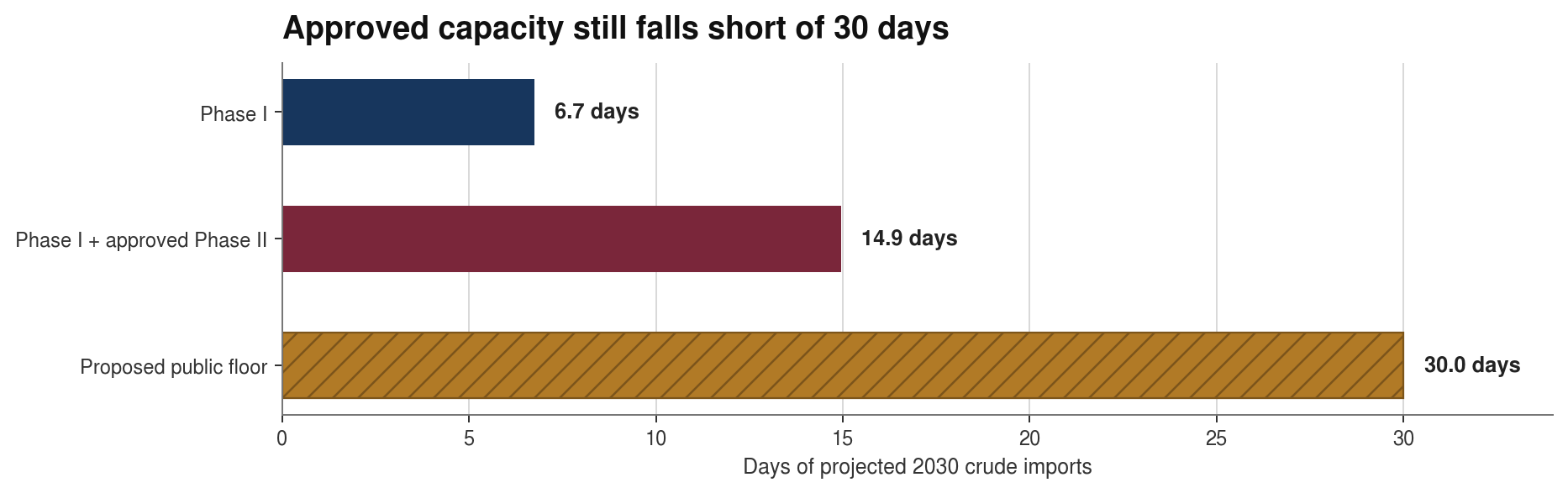
Sources: IEA, PIB and Parliament; author's calculation at 5.8 million barrels a day and approximately 7.33 barrels per metric tonne.
A 30-day domestic public-controlled buffer at the IEA's 2030 import rate would require about 23.7 million tonnes. Even after the approved Phase II is delivered, the gap would be approximately 11.9 million tonnes. This does not mean India must build the entire difference as government-owned coastal caverns. It does mean the current sanctioned ceiling is not yet designed for Viksit Bharat's scale, and the next expansion cannot be justified with day-counts borrowed from 2014 or 2018.
Official reporting also needs one correction. The FY2026-27 petroleum ministry demand for grants contains a note referring to 12.5 million tonnes under Phase II, while Cabinet decisions and the latest parliamentary replies consistently describe the approved Phase II as 6.5 million tonnes. Until a fresh sanction is published, the defensible committed figure is 6.5 million tonnes. The discrepancy should be reconciled rather than allowed to inflate the national total.
Capacity is not the same as readiness
A storage strategy fails if it ends with cavern construction. Oil has to be purchased, the government must be able to call it during an emergency, the crude grades must suit Indian refineries, and ports and pipelines must move it fast enough to matter. Each step removes part of the headline capacity from the volume that is truly usable on short notice.
Table 2 The four numbers a national stock statement should publish
| Measure | Definition | Why it matters |
|---|---|---|
| Nameplate capacity | Maximum designed volume | Infrastructure, whether filled or empty |
| Physical inventory | Crude and products held on the reporting date | Changes with filling, commercial use and releases |
| Legally callable stock | Inventory the government can direct in an emergency | Excludes barrels without enforceable first-call rights |
| Deliverable stock | Callable oil able to reach a compatible refinery within the response window | Tests grades, ports, pipelines and drawdown rates |
Framework proposed in this article, drawing on IEA emergency-stock principles and India's published reserve arrangements.
Commercial participation can reduce the fiscal cost of filling expensive caverns. India already permits part of Phase I capacity to be leased or used through sale-and-purchase arrangements, while retaining emergency rights over the stored crude. Those rights must be explicit, testable and senior to a trader's commercial claim. A barrel counted in the national reserve should have one owner for accounting purposes and one unambiguous emergency instruction.
Product stocks belong in the plan as well. Crude stored underground is useful only if refineries can run and distribution systems can move petrol, diesel, jet fuel and LPG to the regions that need them. A cyclone, port closure, pipeline failure or cyber incident can create a regional shortage even when aggregate national stocks look comfortable. India should therefore combine crude reserves with minimum regional product stocks and regular drawdown exercises.
A Viksit Bharat storage obligation
No official document reviewed for this article sets a sanctioned strategic crude-storage tonnage for 2047. NITI Aayog's Viksit Bharat and net-zero scenarios explore how a much larger economy may use energy, but the report states that it is an analytical exercise rather than government policy. It does not prescribe an SPR volume. Presenting any 2047 tonnage as an existing commitment would therefore be wrong. The policy problem is not that India is missing an announced 2047 target. It is that no binding storage obligation has yet been set for the economy India intends to become.
The absence of a fixed number is an opportunity to choose a better rule. Parliament should establish a minimum number of verified days, calculated against the previous year's net imports and reviewed every five years. A tonnage target set today could become excessive if electrification and domestic production reduce imports, or dangerously small if demand grows faster than expected. Days of import exposure move with the risk.
India is an IEA Association country, not a member legally bound by the agency's 90-day obligation. The benchmark is still useful. IEA members may meet it through a mix of government stocks, agency stocks and mandatory industry stocks, including both crude and products. Overseas stocks count only where treaties or binding bilateral arrangements guarantee access during a crisis. India should adopt the discipline without copying another country's ownership model.
The 2035 milestone would more than quadruple today's public-controlled nameplate capacity to about 24 million tonnes. By 2040, a 40- to 45-day domestic public layer would require about 32 to 36 million tonnes if imports were still 5.8 million barrels a day. The final figure should be recalculated, not frozen. A national total of 90 days on that same import base is roughly 71 million tonnes of crude-equivalent, but it should not all sit in sovereign crude caverns. Mandatory company stocks and ready-to-use products can carry a large share.
Table 3 Proposed milestones for a verified national reserve system
| Milestone | Required action | Measured outcome | Status |
|---|---|---|---|
| By 2030-32 | Finish and commission the approved 6.5 MMT Phase II; publish fill and drawdown tests | 11.83 MMT dedicated nameplate if both projects are completed | Execution of existing sanction |
| By 2035 | At least 30 days of domestic public-controlled crude; 40 days of audited industry crude and products; up to 5 treaty-protected overseas days | About 24 MMT public-controlled crude on the 2030 import base; at least 75 verified national days | Policy recommendation |
| By 2040 | Raise the domestic public layer to 40-45 days and the verified national total to at least 90 days | About 32-36 MMT of public-controlled crude on the 2030 import base | Policy recommendation |
| 2040-47 | Maintain at least 90 verified days through annual recalculation and five-year stress reviews | No fixed 2047 tonnage; capacity follows import exposure and deliverability | Policy recommendation for Viksit Bharat |
Author's proposal. The national total combines public-controlled crude, legally mandated and audited industry crude and product stocks, and only treaty-protected overseas stocks. The portfolio must meet the stated minimum even if an overseas component is unavailable.
Building the system around the barrel
India needs a Strategic Oil Security and Stockholding Act. It should define the national obligation, emergency triggers, release authority, industry duties, reporting standards and penalties for double counting. ISPRL can continue to own and operate facilities, but India also needs a National Oil Stocks Agency with the authority to audit stocks across companies and publish one consistent national measure.
The caverns also need a funded fill plan. Excavating a cavern and buying its oil are separate capital decisions. The government can spread the cost through phased purchases, producer storage agreements, inventory rotation and carefully written commercial leases. Fiscal savings are genuine only when emergency access remains enforceable and the oil is present. The annual budget should report construction money and inventory money separately.
Future sites should diversify geography and logistics. India's first three facilities are valuable but concentrated on the southern coasts. New storage should reduce dependence on a single port, coast or pipeline corridor and should serve eastern, western and inland refining clusters. Site selection must follow public criteria such as geology, refinery compatibility, port redundancy, pipeline reach and drawdown speed. Exact security-sensitive layouts need not be disclosed.
Readiness must be demonstrated through operations. India should run periodic release exercises that move real volumes through ports, pipelines and refineries. Stocks must include a deliberate grade mix, not merely whichever crude was cheapest when the cavern was filled. Regional product obligations should protect aviation, agriculture, freight, emergency services and defence. A reserve that works only in a spreadsheet will fail at the moment it is needed.
International arrangements can add flexibility. The May 2026 India-UAE outcomes included potential ADNOC storage in India and possible Indian strategic stocks at Fujairah. Such arrangements should count toward the national target only after contracts guarantee Indian first-call rights, release timing, shipping access and protection from host-country restrictions. Otherwise they are useful commercial options, not strategic reserves.
Release policy also needs restraint. Strategic stocks are designed for material supply disruptions, not routine attempts to manage prices. The government should publish the conditions for coordinated release, domestic release and replenishment. It should prepare temporary demand measures for a severe crisis, because even a large stockpile lasts longer when consumption can be reduced without damaging essential services.
The reserve Viksit Bharat will need
India's petroleum reserve has moved from zero operational capacity in 2014 to 5.33 million tonnes today. That is real progress and the foundation of national energy security. The approved second phase would more than double the dedicated capacity, but it would still cover only about 15 days of projected 2030 crude imports. Phase II should be completed quickly, filled adequately and described honestly as the next step rather than the finished system.
The larger task is to build a reserve system around the caverns. India needs to know how much oil is physically present, how much the government can command and how quickly it can reach the economy. Those numbers should be audited even when sensitive site details remain confidential. Without that discipline, capacity announcements create reassurance without proving readiness.
A richer India will move more people and goods, fly more often and manufacture more materials. Electrification will curb part of the import bill, but it will not remove the need for reliable liquid fuels by 2047. A rolling 90-day national obligation, backed by 40 to 45 days of domestic public-controlled crude and strong industry product stocks, would give Viksit Bharat a reserve suited to its scale. That is the gap the current programme has not yet been designed to close.
India has built the first line of energy security, but its current storage programme is not yet designed for the economic scale, import exposure and strategic risks of Viksit Bharat. The economic value of storage lies in the decisions it prevents a crisis from forcing on the country. The next phase should therefore be judged by verified days of protection rather than cavern announcements alone. It must count the right barrels, move them under pressure and grow with the risk it is meant to cover.